
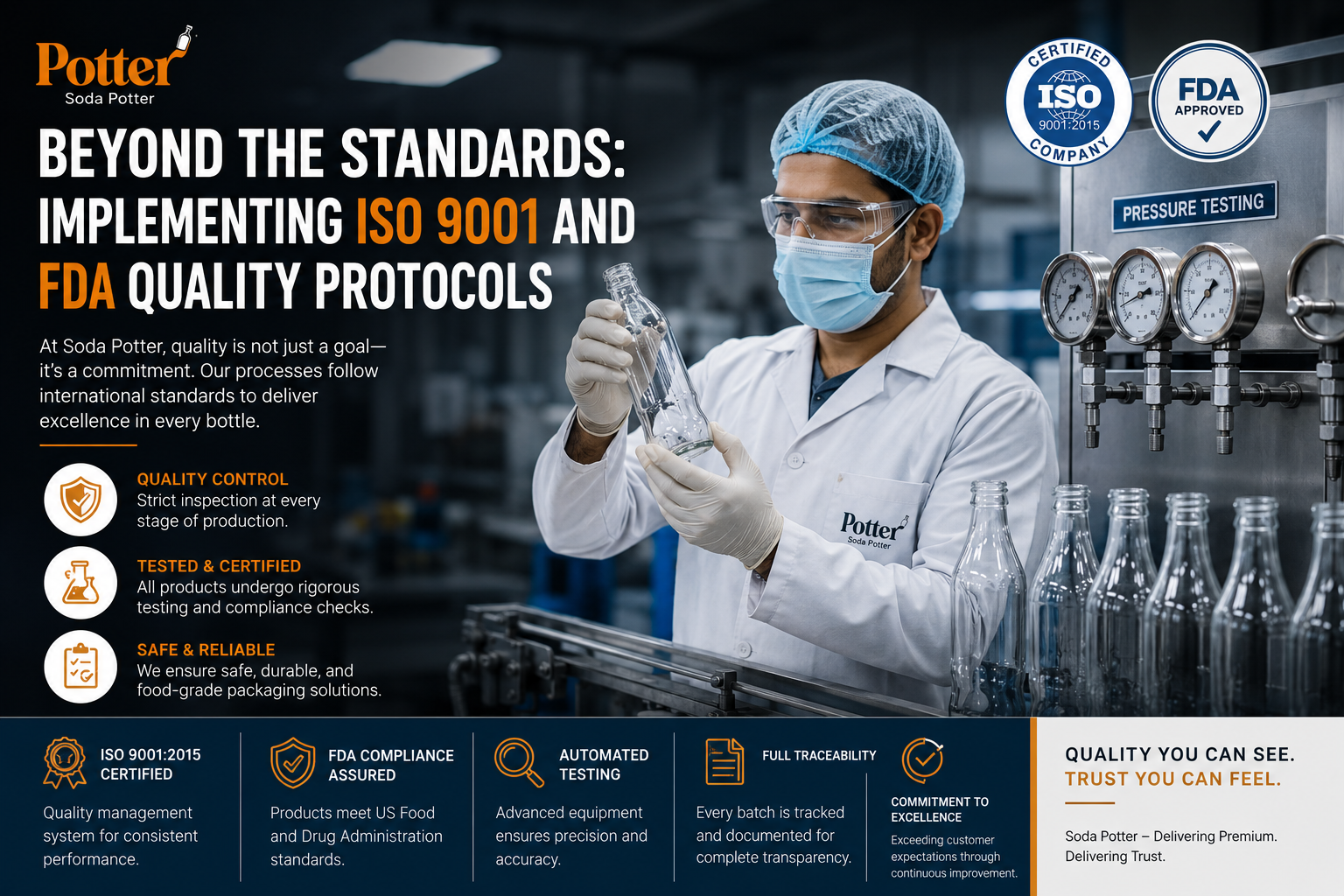
When you manufacture packaging for products that people consume, safety and quality are non-negotiable. At Soda Potter, we maintain a comprehensive quality management system that far exceeds basic regulatory requirements. Our facilities are certified to ISO 9001:2015 standards, and all of our manufacturing processes comply fully with US Food and Drug Administration (FDA) protocols for food-contact materials.
Raw Material Auditing
Quality control starts with our suppliers. Every batch of silica sand, soda ash, and raw polymer delivered to our plants must be accompanied by a chemical analysis certificate. We perform random testing in our in-house laboratories to verify purity and detect any trace metals or contaminants. By ensuring our raw inputs are flawless, we prevent structural defects before manufacturing even starts.
"Quality is not something we check at the end of the line; it is something we build into every single step of the process. If the raw material fails, the final bottle fails." — Elena Rostova, Director of Quality Assurance
Automated In-Line Inspection
As bottles exit our ovens, they pass through high-speed optoelectronic inspection stations. High-resolution cameras capture up to 30 images of each bottle from multiple angles. Advanced machine-learning algorithms analyze these images in real-time, checking for defects such as bubbles, checks (micro-cracks), stones, and dimensions that deviate by more than 0.1mm. Defective units are automatically blown off the conveyor belt by compressed air jet systems.
Zero-Defect Goal: Our automated optoelectronic inspection lines process up to 350 bottles per minute, ensuring that not a single defective unit reaches packaging.
Pressure and Thermal Shock Testing
Beverage containers, especially those holding carbonated sodas, must withstand significant internal pressure. We pull random samples from our production lines every hour to undergo destructive testing. In our test bays, bottles are subjected to extreme internal hydrostatic pressure until they burst. Our minimum standard is 150 PSI—far above the typical pressure of a carbonated soft drink. We also perform thermal shock tests, plunging hot bottles into cold water to ensure they can survive rapid temperature changes during pasteurization and washing.
Discussion (0 Comments)
Join the conversation. Share your thoughts on this publication below.