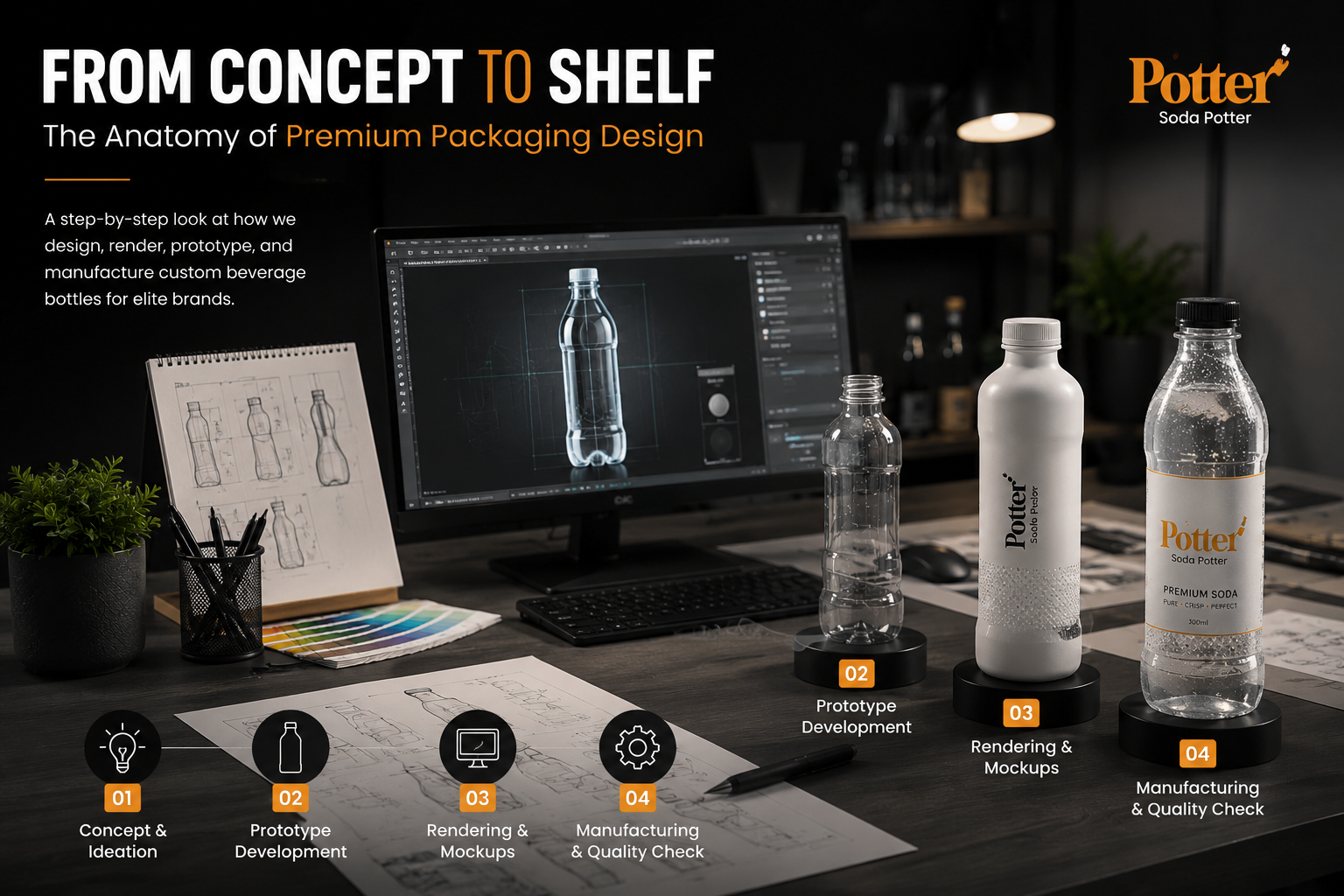
Designing a luxury beverage container is a journey that bridges creative expression and rigid engineering. A bottle must be visually striking, comfortable to hold, and perfectly optimized for high-speed filling lines. At Soda Potter, our design studio works hand-in-hand with our manufacturing team to ensure that what looks stunning on paper performs flawlessly in production. Here is our step-by-step design process.
Step 1: Creative Concept and Hand Sketching
We begin with a blank sheet of paper and an intensive brainstorming session. We discuss the brand's history, target demographic, and flavor profiles. Our designers sketch initial ideas by hand, focusing on silhouette, grip, ergonomics, and how light will interact with the bottle's curves. This organic stage allows us to explore unique forms without the constraints of software.
Step 2: 3D CAD Modeling and Digital Rendering
Once a concept is approved, it is imported into advanced Computer-Aided Design (CAD) software. Here, we define the exact physical dimensions, volume capacity, and glass distribution. We then generate photo-realistic 3D digital renderings, simulating how different glass colors (flint, amber, emerald) and label layouts will look under realistic lighting conditions. This gives our clients a clear visualization before physical work begins.
"3D rendering lets us test how a bottle reflecting light on a shelf behaves. We can adjust the angle of a facet or the depth of an embossing to ensure maximum visual impact." — Liam Tanaka, Senior 3D Designer
Step 3: Rapid Prototyping
Next comes physical reality. Using our industrial 3D printers, we print a full-scale plastic model of the bottle. This prototype is used to test the ergonomics—how the bottle feels in the hand, how easy it is to pour, and how it fits into standard beverage holders. It also allows us to verify the exact label placement and test how the physical prototype behaves on conveyor tracks.
Rapid Validation: By utilizing high-resolution resin 3D printers, we can evaluate a new design's physical volume and weight distribution in less than 24 hours.
Step 4: Mold Engineering and Production
With final approval, our mold shop cuts the design into heavy steel or bronze molds using high-precision CNC machines. These molds are polished to a mirror finish, as any imperfection in the steel would transfer directly onto the finished glass. Finally, the molds are mounted in our production lines, and the first physical run of premium glass bottles begins, bringing the design journey to a successful conclusion.
Packaging Performance Comparison
| Metric / Parameter | Standard Glass | Lightweight PET | Recycled Cullet Glass |
|---|---|---|---|
| Carbon Footprint | High (1.2 kg CO2e) | Medium (0.8 kg CO2e) | Low (0.5 kg CO2e) |
| Durability / Drop Rate | Fragile (5% loss rate) | High (0.01% loss rate) | Fragile (5% loss rate) |
| Recyclability Cycle | Infinite (100% pure) | Moderate (Downcycles) | Infinite (100% pure) |
| Aesthetic Premium | Elite / Luxury | Modern / Utility | Elite / Unique Tint |
Discussion (0 Comments)
Join the conversation. Share your thoughts on this publication below.